
Regular and Substantive Interaction
Introduction
At its core, Lasallian education emphasizes a student-centered approach to education marked by an inclusive community that ensures no student is left out as they are provided a quality education that prepares them for ethical lives of service and leadership. These Core Principles of the Lasallian educator should also guide how we teach students in online environments. We build community and show students our care for them through the hospitality of our class structures and the ways that we invite them into the life of education and research.
For these reasons, Saint Mary’s University of Minnesota views the expectations of Regular and Substantive Interaction as not merely a regulatory requirement, but as the baseline for serving our students. We encourage our faculty to approach them as practical ways to apply our principles in the classroom.
Regular and Substantive Interaction (RSI) in distance education refers to meaningful and consistent engagement between students and their instructors and the educational content. These interactions are critical to fostering high-quality learning, requiring instructors to actively engage with students in a meaningful manner, ensuring consistent, tailored support that aligns with the course content and outcomes. This ensures that the instructor is actively present and encourages students to move beyond passive absorption of information to active participation in the learning process.
Regular Interaction
An institution ensures regular interaction between a student and an instructor or instructors, prior to the student’s completion of a course or competency, by:
- Providing the opportunity for regular interactions with the student on a predictable and scheduled basis commensurate with the length of time and the amount of content in the course or competency; and
- Monitoring the student’s academic engagement and success and ensuring that an instructor is responsible for promptly and proactively engaging in substantive interaction with the student when needed on the basis of such monitoring, or upon request by the student.
Substantive Interaction
Substantive interaction is engaging students in teaching, learning and assessment, consistent with the content under discussion, and also includes at least two of the following:
- Providing direct instruction;
- Assessing or providing feedback on a student’s coursework;
- Providing information or responding to questions about the content of a course or competency;
- Facilitating a group discussion regarding the content of a course or competency; or
- Other instructional activities approved by HLC or the program’s accrediting agency.
Synchronous Meeting Times and Online Office Hours for Asynchronous Courses
Syllabi for online or hybrid courses with synchronous components should make clear the meeting dates and times required for synchronous meetings, and must align with what was shared with students in the course schedule.
Syllabi for hybrid courses should make clear in-person meeting dates and times, which weeks are online, and what the expectations are for engagement during the online weeks.
A minimum of one hour of online office time must be scheduled weekly for asynchronous online courses. Online office hours represent scheduled times when an instructor is online via video technology (Zoom, Google Meets, or similar) to answer student questions or discuss course topics. The days and times of weekly online office hours must be listed in the syllabus and Canvas so that students are aware of the schedule at the start of the course. Instructors teaching online courses with a combination of synchronous and asynchronous online sessions are also encouraged to schedule online office hours.
Structured Office Hours
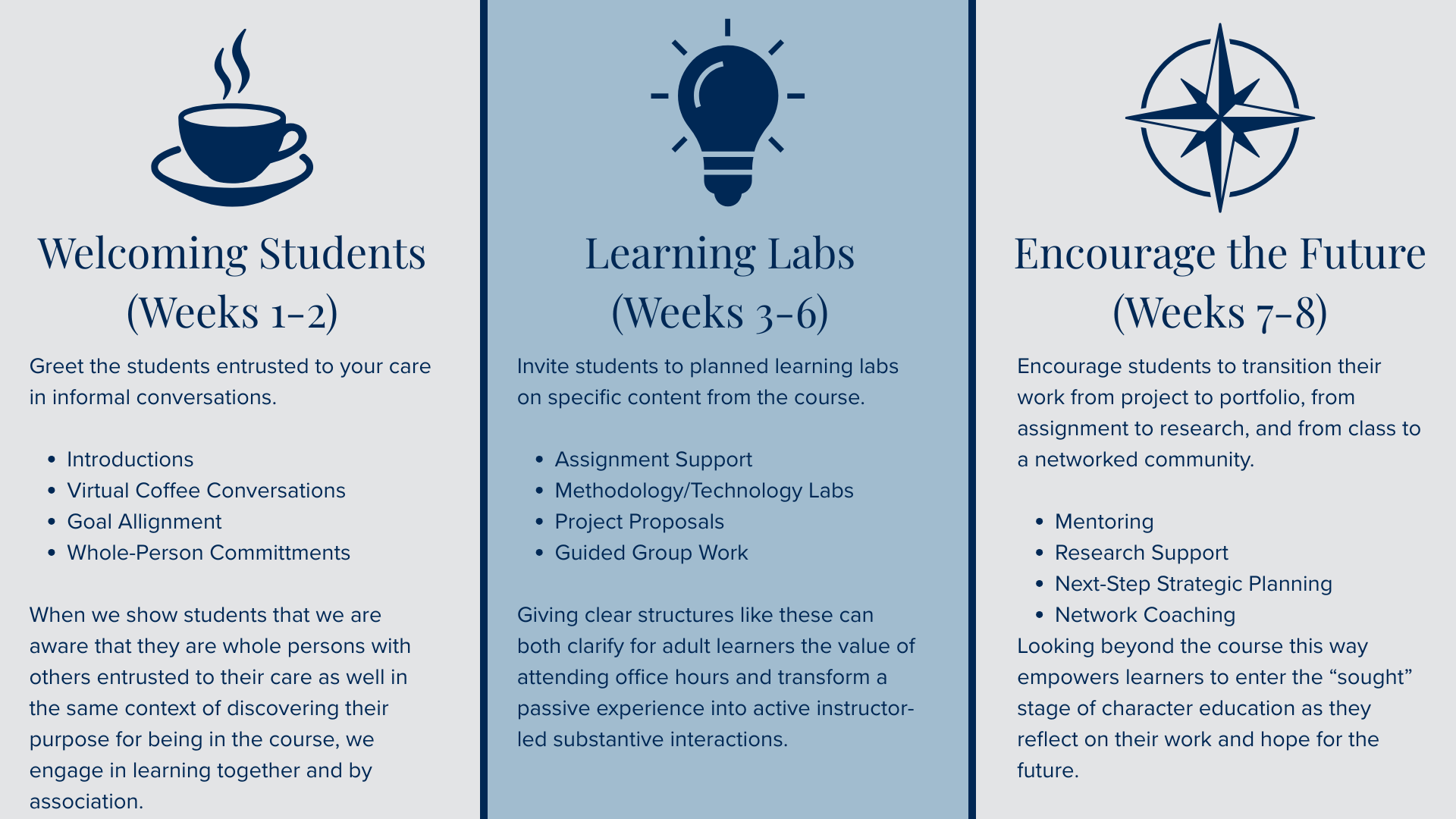
Traditional office hours can become underutilized when students see them as passive, unstructured spaces, especially for working adult learners balancing careers and families. The focus offered by RSI requirements can help us envision office hours instead as high-value collaborative learning spaces with instructor-led structures designed to move students from the caught and taught stages of character development to the sought stage of a lifelong learner.
Think of structure as an invitation to engagement. As the philosopher of education, Sam Rocha, puts it, the “longing” for order felt by our students “is not something to be cast aside lightly” because “the ordered outline of the teacher can offer an invitation into a responsible home, a place to dwell, to be-with, an offering to and for the other” (The Syllabus as Curriculum, page 183).
The infographic below, inspired by Viji Sathy’s (OneHE, 2020) “Using Structured Office Hours to Improve Student Engagement,” provides a relational roadmap for office hours to promote learning together and by association.
Next Steps in Engagement
RSI is essential for our Lasallian mission to provide quality education, but we can go further in our zeal for the learners entrusted to our care. Beyond instructor-led RSI-compliant activities, office hours, and feedback routines, scheduled online weeks should also feature holistic, layered student touchpoints.
An individual reading, assignment, or activity provided as homework without an accompanying exchange of ideas within the class should not be the only activity in which a student is engaged during an online week. To invite an inclusive community of inquiry, make sure to include student-to-student activities each week such as discussions, group projects, and peer reviews. For more ideas on how to develop engaging activities in Canvas, visit the reIMAGINE Resources.